
A real problem
Engagement just hit a ten-year low. It’s still the only thing most tools measure.
Most surveys measure who shows up. The OwnIt Index™ measures who leans in and who pulls back… when it matters most.
Built for healthcare, corporate, and mission-driven teams · Confidential by design · Grounded in decades of research.
From Dan Diamond, MD — a physician who’s led disaster medical teams into some of the worst days people ever live through, like the Haiti earthquake and Hurricane Katrina. That’s where you learn fast who carries the load, and who runs away.
In 2024, U.S. engagement fell to its lowest in a decade. The headline number hides worse news underneath.
Source: Gallup, U.S. Employee Engagement Sinks to 10-Year Low(2025, reporting 2024 data). “At or below the tipping point” combines the 52% not engaged with the 17% actively disengaged.
Most tools stop at that number and call it a strategy. But it’s hard to change what you can’t see.
Picture a ladder. Engaged sits dead center: I’m doing my job. Below it, people take from the work. Above it, they give to it. The OwnIt Index™ shows who’s climbing and who’s sliding, especially under pressure.
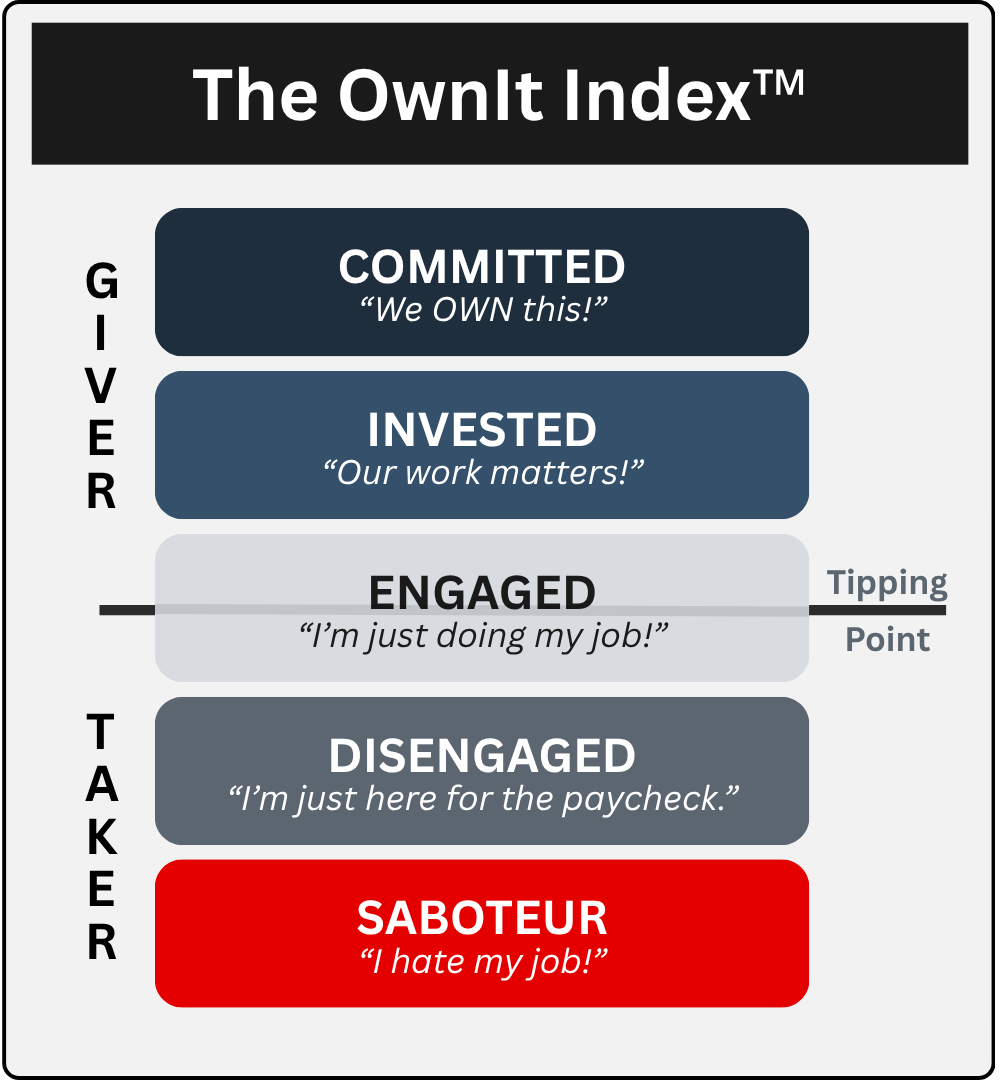
Below the line, people take from the work, from quiet minimum-effort to open sabotage. Above it, they give: first investing, then owning the outcome. Simon Sinek says it well: financially invested people want a return; emotionally invested people want to contribute. The whole game is who climbs into ownership, and who slides back.
The Index reads work life through three lenses, and asks each one twice: on a calm day and under pressure. The difference between those two readings matters.
Where do I sit on the ladder, and which way do I move when it’s hard?
Does the team pull together under load, or fracture and self-protect?
Does the organization lead from shared ownership, or retreat into fear?
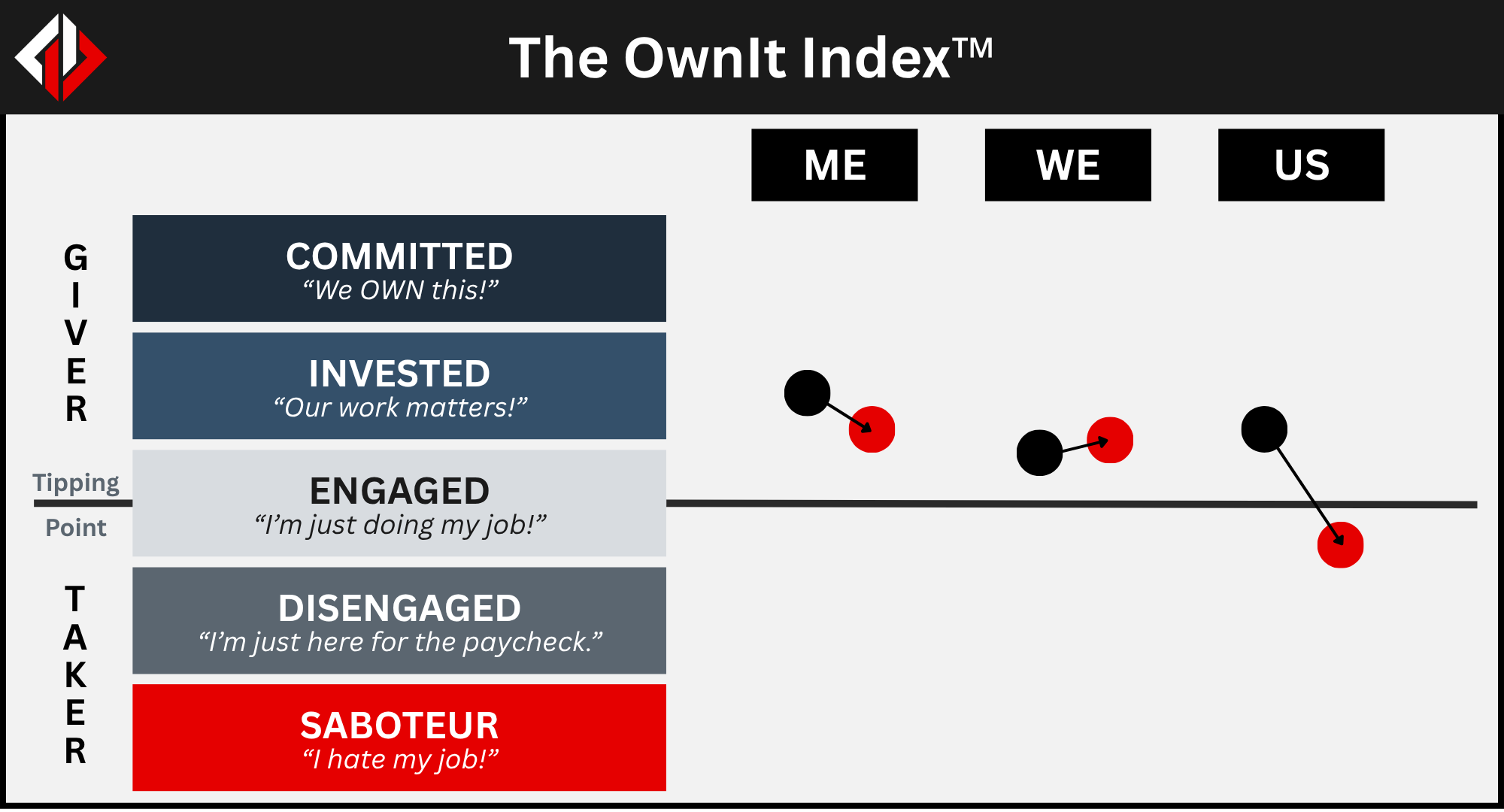
Illustrative example. Black dots show a typical day. Red dots show what happens under pressure.
Anyone can own the work on a calm week. Hold or climb when it’s hard, and that’s the giver mindset.
Depth perception comes from two eyes viewing the same scene from slightly different places. When people score as givers but see the organization as a taker, that difference isn’t a flaw in the data. It’s the third dimension a single-lens survey can never show you, and it’s exactly what a “From Me to We” conversation is built to move.
The OwnIt Index™ is new. But every rung and lens maps to a construct psychology has studied for decades.
I didn’t learn this from a journal. I learned it in disaster zones, watching ordinary people either step toward the work or step back when it mattered most. The research below supports what I learned in the trenches.
The work feels like an extension of yourself, so you steward it. Decades of research tie it to responsibility and stewardship.
Purpose, calling, and work engagement predict satisfaction, commitment, and performance.
Psychological capital and how you read stress are both developable. They shape whether you hold or slide when the load comes on.
Much of what gets labeled “burnout” is really the wound of being kept from doing right by the people you serve. A systemic problem, not a personal failing.
The Index measures ownership, meaning, and belonging, plus the forces that move them. Then each private report turns those results into specific next steps, every one backed by research: recovery habits, psychological safety, self-compassion, and more.
The Index itself is new, so we won’t wave a banner of 250,000 evaluations it hasn’t earned. The science is proven today. And because you can re-administer it, your own before-and-after becomes the proof, measured on your team, not borrowed from someone else’s.
Data is only as good as the action it unlocks. The OwnIt Index™ gives each audience what it needs, without breaking the confidence that keeps the data honest.
Confidential by design. Individual results stay in each person’s private vault. Leaders see team and organization patterns, never a single person’s answers. That’s why people answer honestly, and why the signal is worth trusting.
See who carries the load before you find out the hard way.
Whether you lead a hospital floor, a company, or a mission, it starts with one conversation about what measuring ownership could look like on your team.